
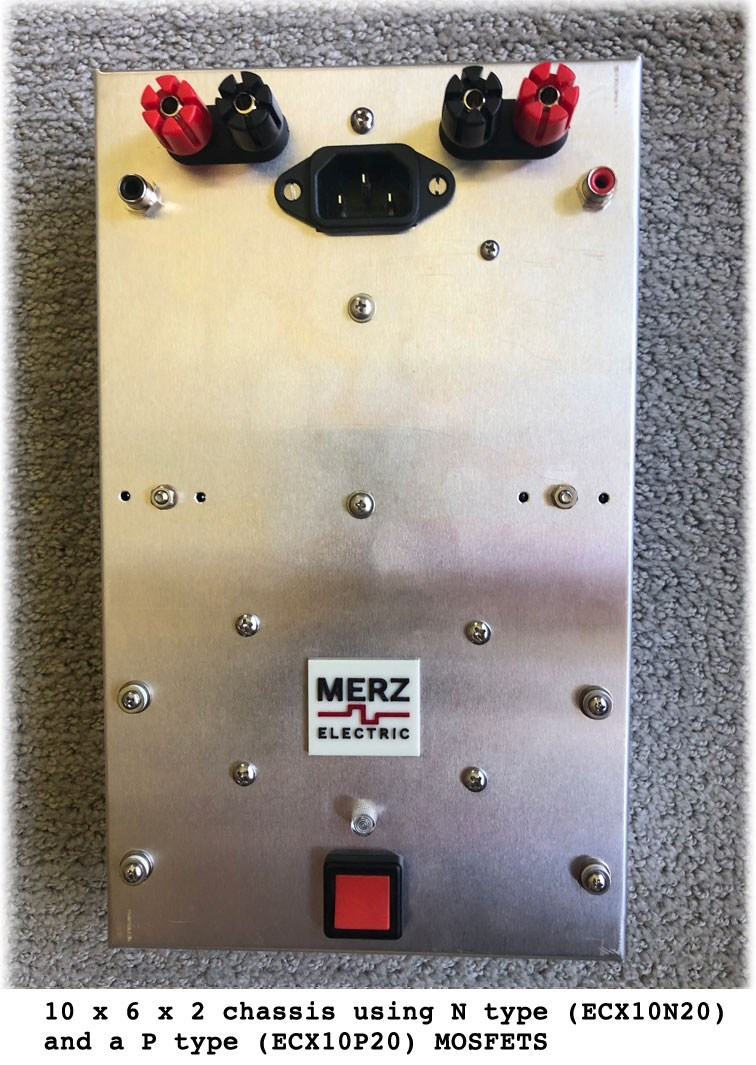
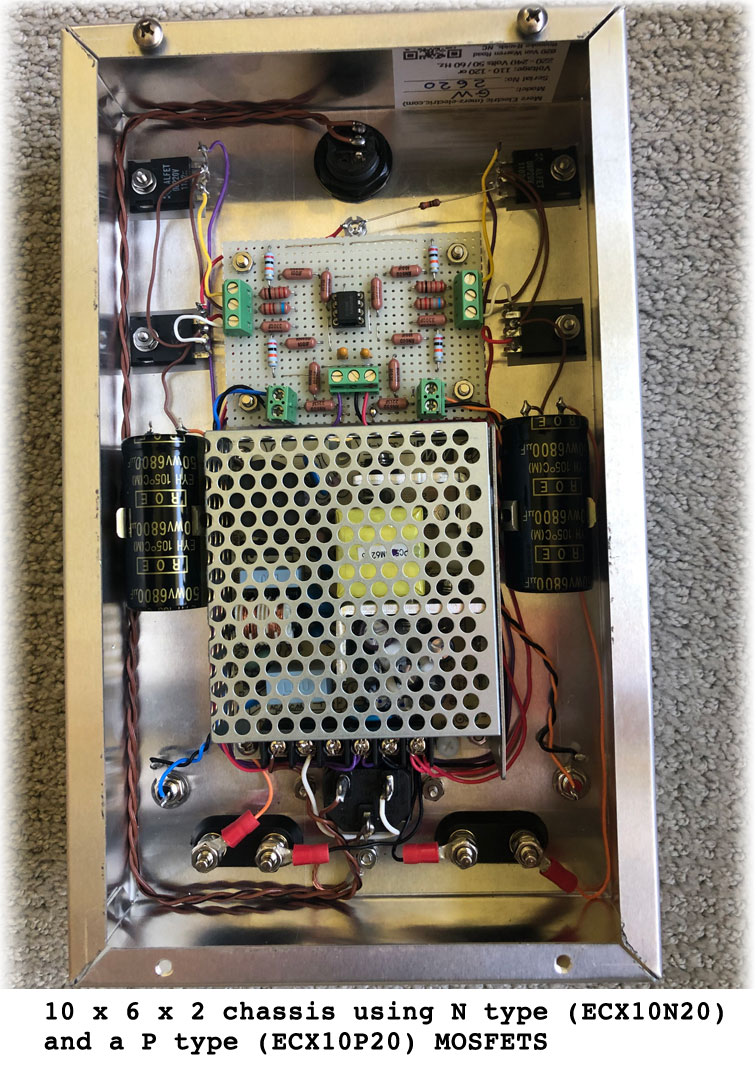
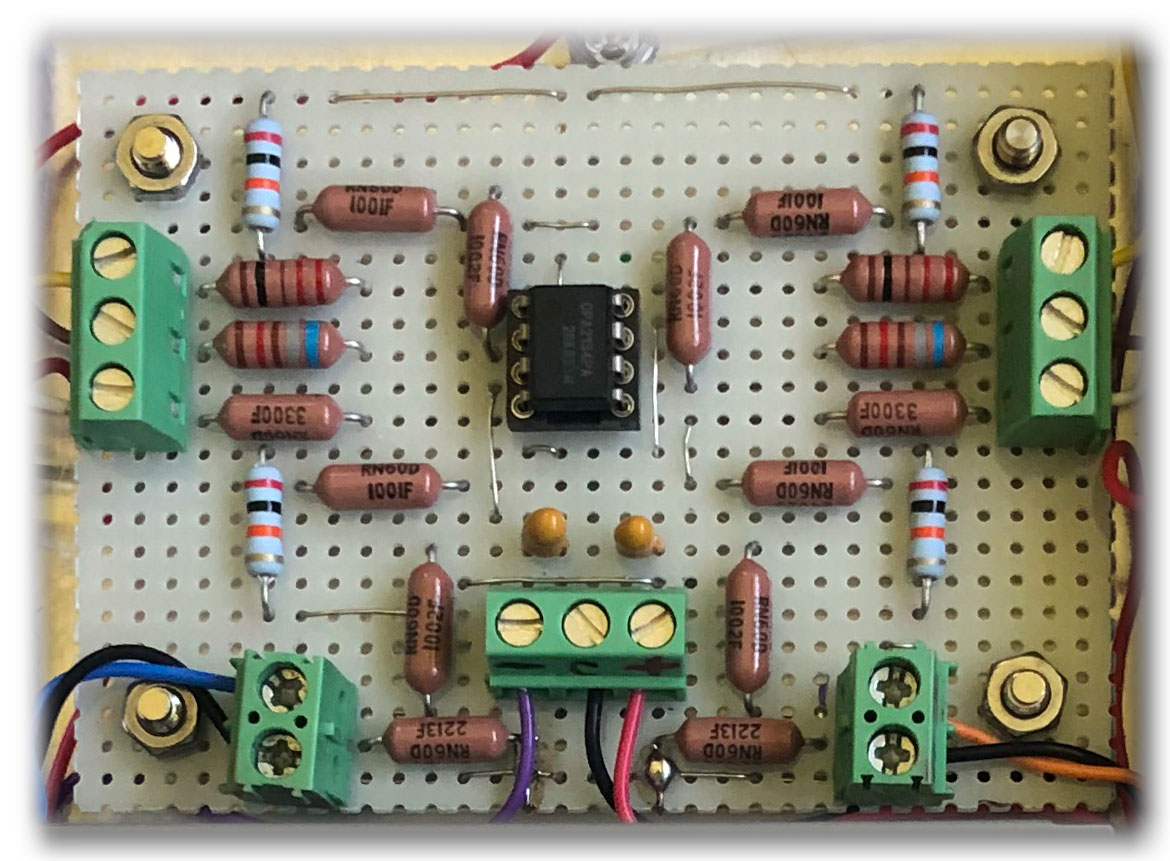
The GW is currently for sale at $225 with $50 shipping and handling to all 50 U.S. states.
Model GW Description
Cool running solid-state class AB amplifer using op-amps and mosfets, producing a solid 8 Watts per channel into an 8Ω Load with a warm "tube like sound" without the hassle.
Specifications (both channels driven)
Power Output: 4 Ω Load, 9 Watts / 8 Ω, 8 Watts / 16 Ω, 4 Watts (limited by the power supply voltage)
Damping Factor: 4Ω, 50 / 8Ω, 100 / 16Ω, 200
Input Sensitivity (VRMS) 4Ω, .75 / 8Ω, 1 / 16Ω, 1
Input Impedance: 221 K
Output Impedance: .08Ω
Feedback db: 18
Power Requirement: 100 – 240 V 50 / 60 Hz.
Power Consumption: No Signal, 30 Watts / Full Power Output, 60 Watts
Dimensions: 10” D x 12” W x 3 5/8 H
Weight: 3 Lbs.
Circuit Description
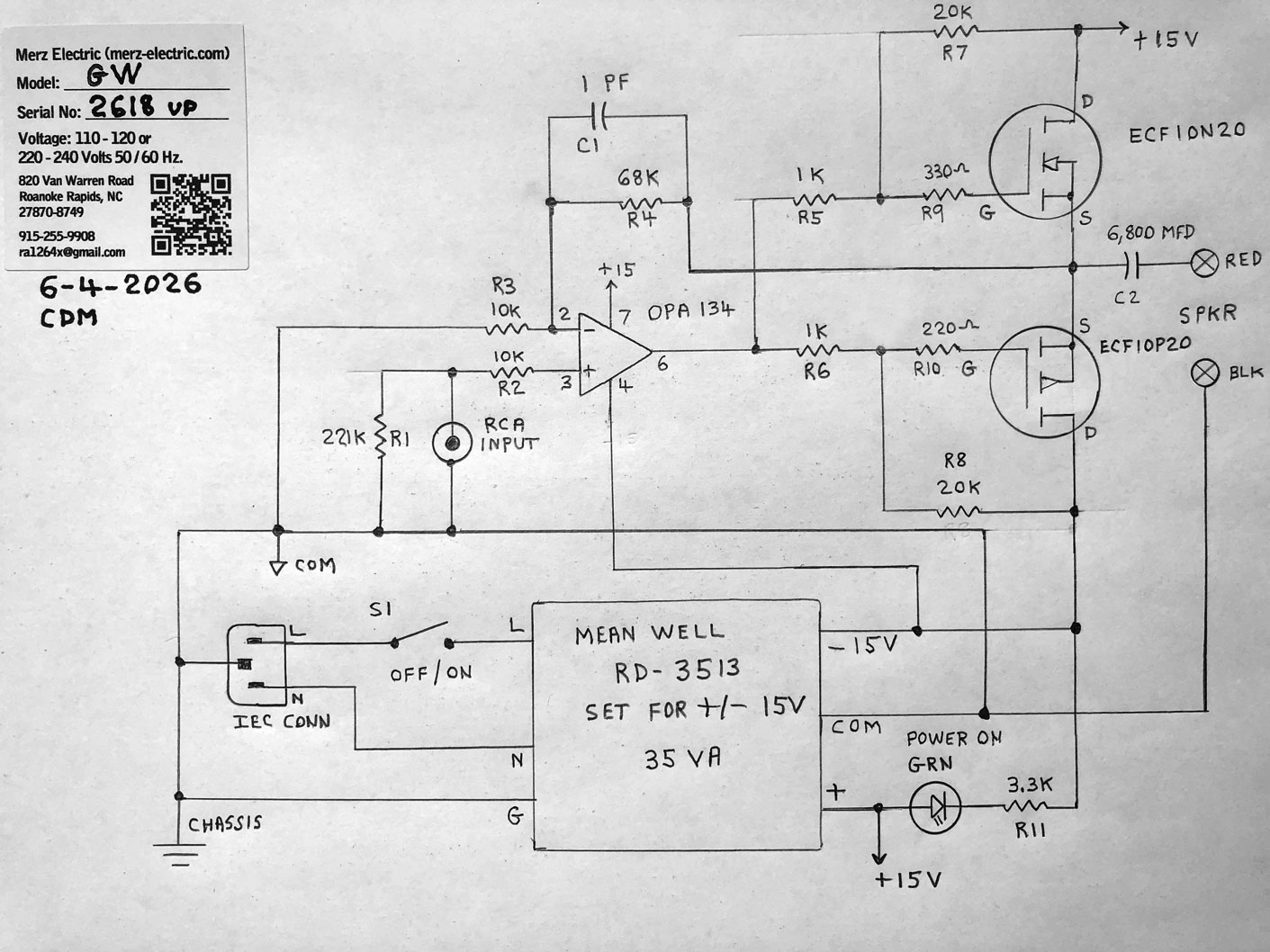
The signal input is coupled directly to the high impedance (pin 3) input to the OPA 134 high slewing
operational amplifier which is wired in the non-inverting configuration with a gain of about 7.8
The ouput of the OPA 134 (pin 6) is fed to the junction of R5, R6 and then to the gates of the two N and P
channel MOSFETS via parisitic suppression resistors R9, R10.
Idle current bias is set via the voltage divider string formed by R5, R6, R7, and R8. This current is in the
range of 50 to 100 mA and is high enough to prevent crossover distortion without producing an excess
amount of heat. The amplifier output is taken the source pins of the two P – P (push-pull) MOSFETS and
is coupled to the speaker via coupling capacitor C2. Overall feedback is taken from the MOSFET source
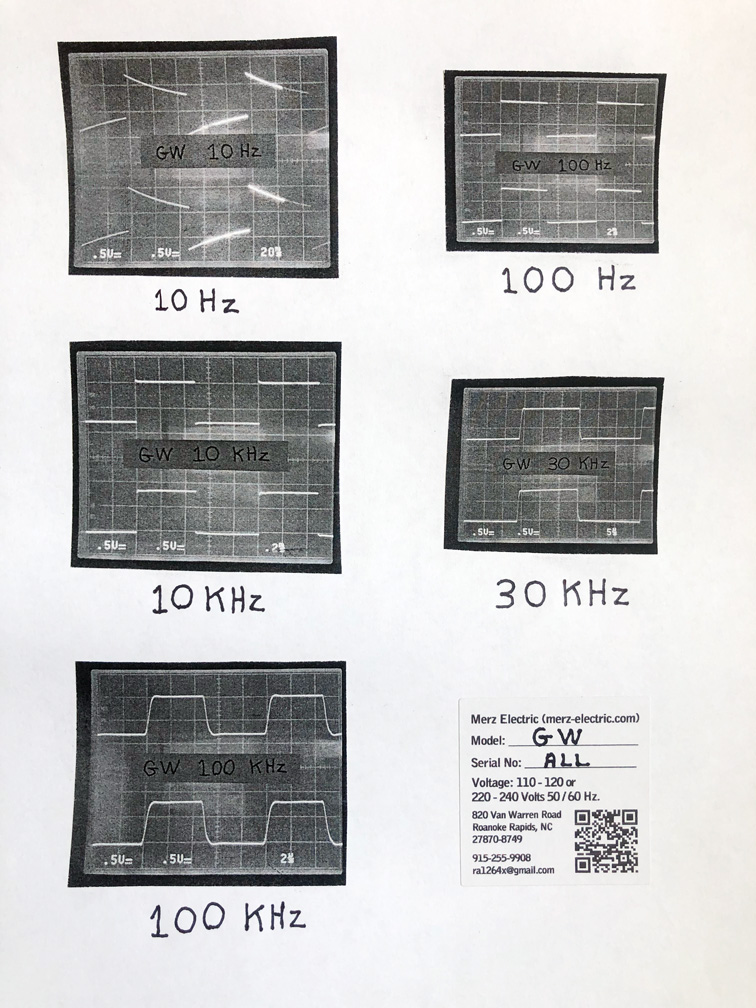
pins via R4 to the operational amplifier – input (pin 2) Capacitor C1 cleans up minor peaks in the square
wave performance, which is excellent over the frequency range of 20 Hz. To 100 kHz. The power supply
for both channels is from the 35 VA switching power supply that is set for an output of +/- 15 VDC (the
adjustment potentiometer on the power supply is set full clockwise)
The Circuit and Associated Parts
(Click to enlarge)
The Square Waves
Square wave photos don’t capture the full picture, but they provide a useful indication of how flat the amplifier’s response is. While square wave performance doesn’t directly reflect how the amplifier will sound, it does suggest a wide frequency response and minimal "ringing."
For clarity, one channel is shown here, though both channels were driven during the test.
(Click to enlarge)
Contact & Sales
Copyright © All rights reserved | Merz Electric